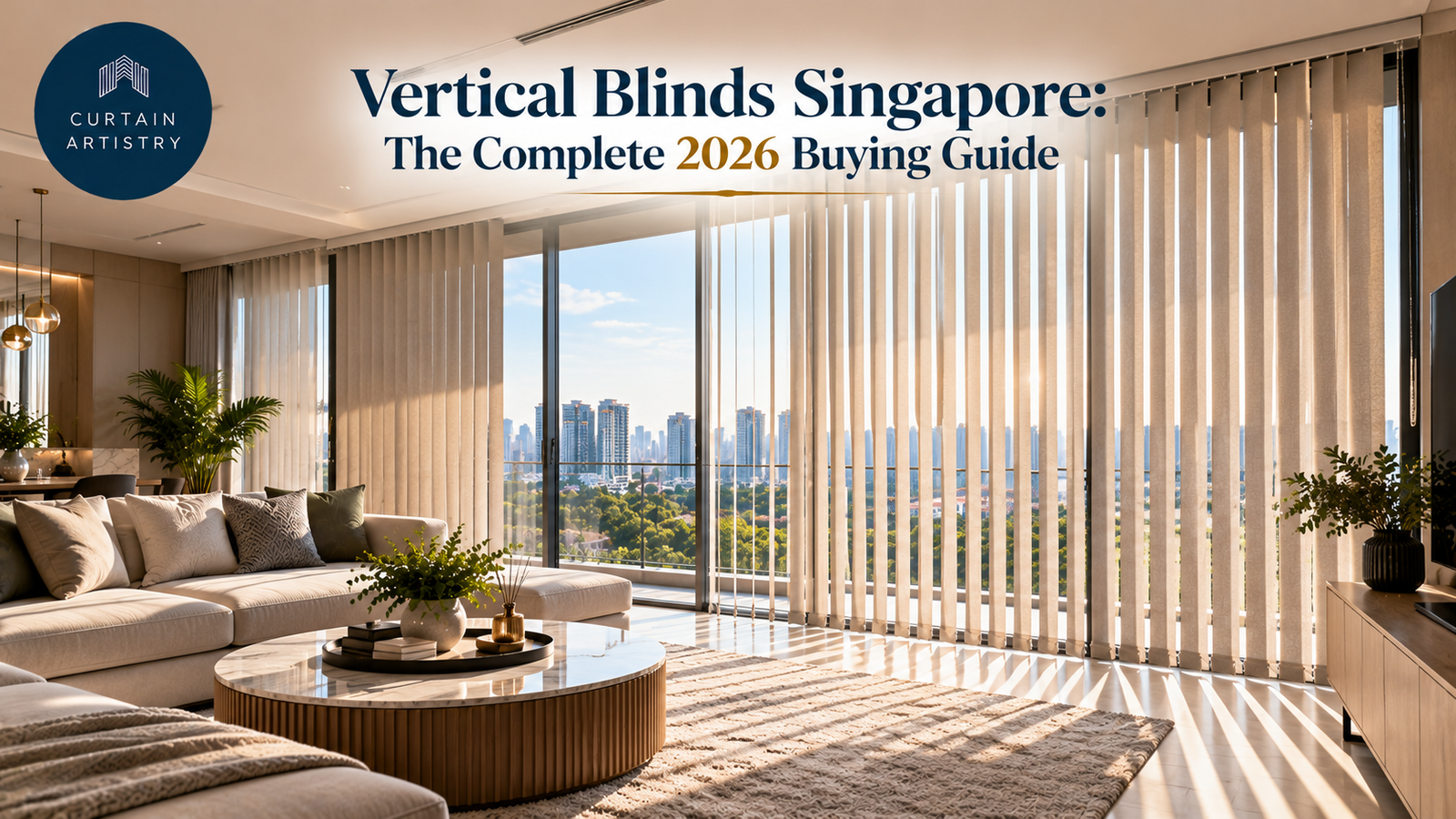
Walk into almost any office in Singapore and you will see them: long, clean slats hanging from a ceiling track, tilting in unison to soften the afternoon sun. Vertical blinds have been an office staple for decades — but here is what many homeowners do not realise: they are also one of the most practical window treatments for HDB flats and condos, especially for sliding doors and wide windows.
Yet vertical blinds are also one of the most misunderstood products in the curtains and blinds world. Buy the wrong material, and the slats swing noisily every time your ceiling fan runs. Choose the wrong opacity, and your “blackout” blinds still leak light at the edges.
This guide covers everything you need to know before buying vertical blinds in Singapore in 2026: the types available, honest pros and cons, real price ranges, where they work best, and the mistakes to avoid.
What Are Vertical Blinds?
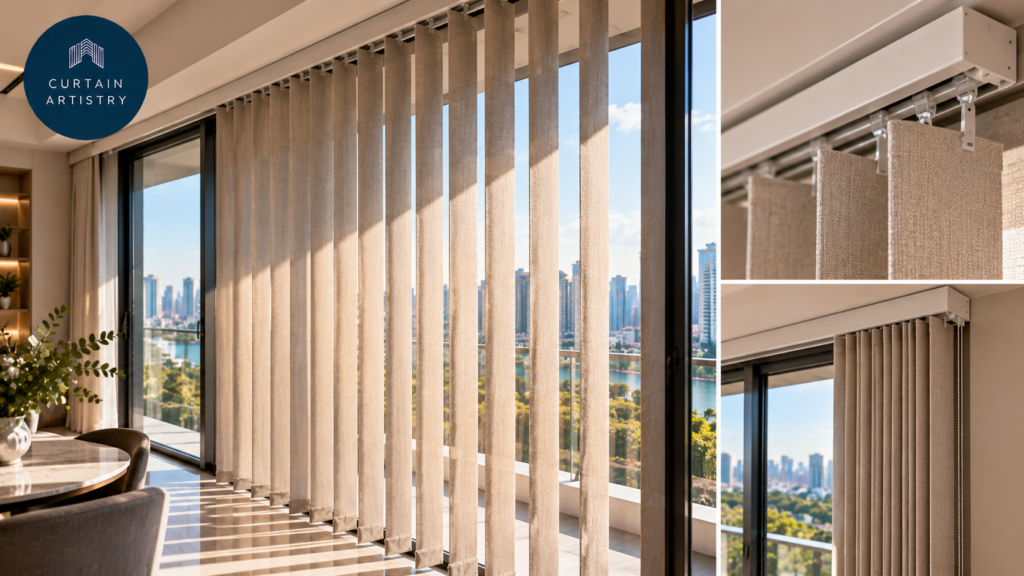
Vertical blinds consist of individual upright slats — also called vanes or louvres — suspended from a horizontal headrail track. Each slat can rotate up to 180 degrees to control light, and the whole set can be drawn to one side (or split from the middle) like a curtain to fully open the window.
Standard slat widths are 89mm (3.5 inches) and 127mm (5 inches). The wider 127mm slats are more common in Singapore homes because they suit larger windows and sliding doors, need fewer slats overall, and give a cleaner, more modern look.
The operating mechanism is usually a cord, a wand, or a motorised system. At Curtain Artistry, vertical blinds can
also be integrated with smart home systems for remote or voice control.
Types of Vertical Blinds Available in Singapore
Not all vertical blinds are made equal. The material of the slats determines how the blinds look, how long they last in Singapore’s climate, and how much they cost.
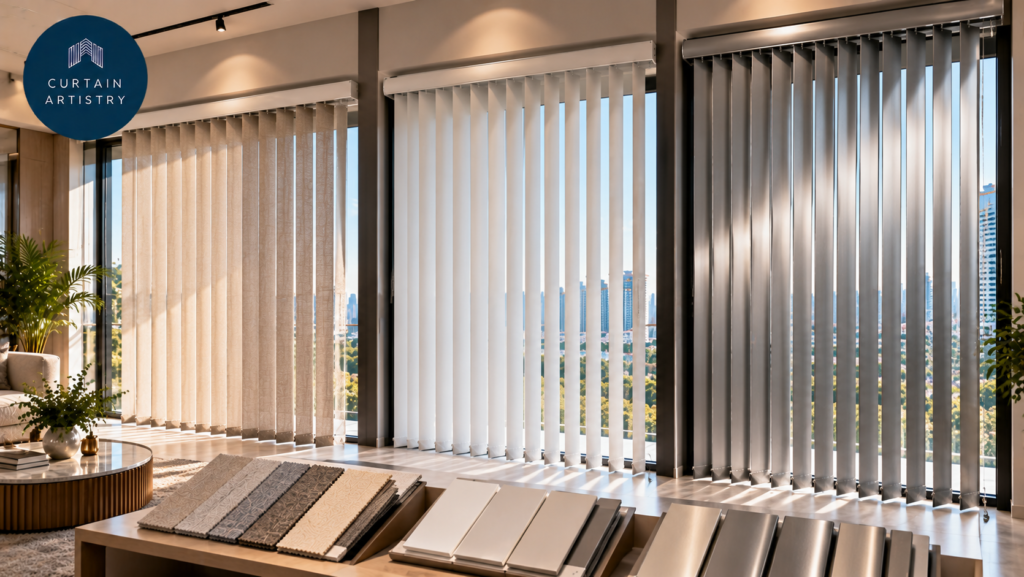
Fabric Vertical Blinds
The most popular choice for homes. Fabric slats come in the widest range of colours, textures, and opacity levels — from sheer and light-filtering to dim-out and blackout. They look softer and more “residential” than PVC or aluminium, and they pair well with modern Scandinavian, Japandi, and minimalist interiors.
Best for: Living rooms, bedrooms, and anywhere you want a warm, homely feel.
PVC Vertical Blinds
PVC slats are rigid, wipeable, and highly resistant to moisture. They will not warp, and they handle Singapore’s humidity without complaint. The trade-off is a slightly more “commercial” appearance, which is why they remain the default choice for offices, clinics, and F&B outlets.
Best for: Offices, kitchens, commercial spaces, and budget-conscious projects.
Aluminium Vertical Blinds
Less common in Singapore, aluminium slats are durable and give a sleek, contemporary finish. They are heavier than fabric or PVC, so they need a sturdier track system, and they can be noisier in breezy conditions.
Best for: Modern commercial interiors where a metallic finish suits the design.
Where Vertical Blinds Work Best
Sliding Doors and Balcony Doors
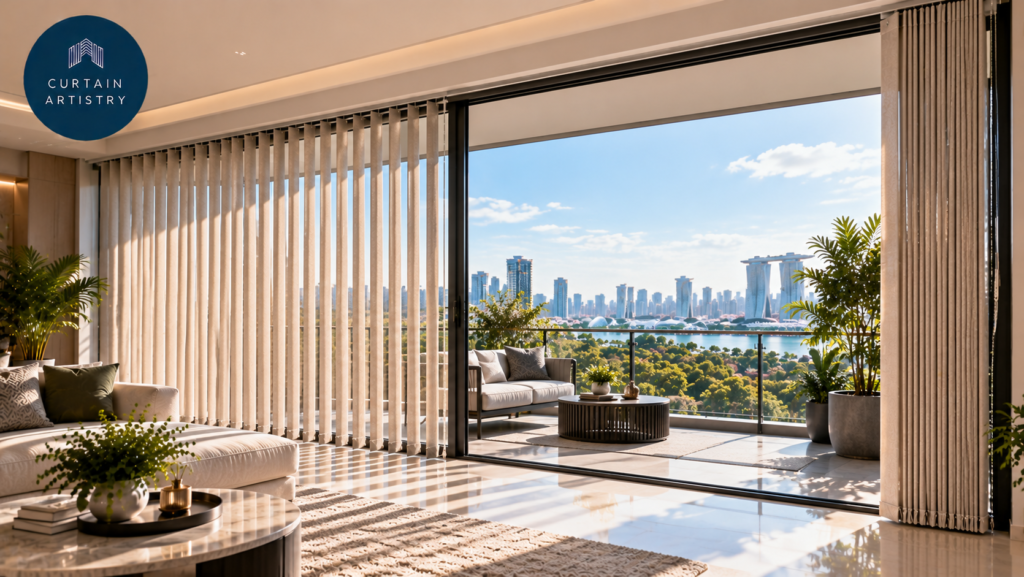
This is the number one use case in Singapore. A sliding door needs a window treatment that moves sideways — exactly how vertical blinds operate. Curtains work too, but vertical blinds stack into a much slimmer profile when open, and individual slats can be replaced if damaged without replacing the whole set.
Wide Windows and Floor-to-Ceiling Glass
For windows wider than about 2 metres, horizontal blinds and roller blinds start to look stretched and become heavy to operate. Vertical blinds are designed for width: the track handles spans of 3–4 metres comfortably, and
the vertical lines visually add height to the room.
Home Offices and Study Rooms
If you work from home, you need two things: no screen glare during video calls, and enough daylight to stay alert. Tilting the slats lets you bounce light off the ceiling — bright room, zero glare. It is a level of control curtains simply cannot match.
Bedrooms (With the Right Fabric)
Here is an honest caveat: vertical blinds are not true blackout products. Even with blackout fabric, thin lines of light seep through the gaps where slats overlap. If you are a light sleeper, pair them with a blackout roller blind behind, or choose curtains for the bedroom instead. For guest rooms and children’s rooms where dim-out is enough, they work well.
Vertical Blinds vs Curtains: Which Should You Choose?
Comparison — Vertical Blinds vs Curtains:
- Light control: Vertical blinds excellent (tilt slats to any angle); Curtains open or closed, limited in-between
- Best for wide openings: Vertical blinds ideal for sliding doors and wide windows; Curtains work but need a lot of fabric
- Blackout ability: Vertical blinds dim-out to near-blackout (light leaks at slat edges); Curtains true blackout possible with the right lining
- Cleaning: Vertical blinds — wipe individual slats, fabric slats detachable; Curtains — machine or dry wash depending on fabric
- Durability: Vertical blinds — slats individually replaceable; Curtains — one tear can mean replacing the whole panel
- Look and feel: Vertical blinds — clean, structured, modern; Curtains — soft, layered, cosy
- Cost for large windows: Vertical blinds usually more economical; Curtains — premium fabrics add up fast
The short answer: choose vertical blinds for sliding doors, wide windows, and precise light control. Choose curtains for bedrooms where true blackout matters, or when you want a softer interior look. Many Singapore homes use both — blinds for the living room sliding door, curtains for the bedrooms.
How Much Do Vertical Blinds Cost in Singapore?
Based on current market rates in Singapore, custom-made vertical blinds typically cost:
- PVC / standard fabric (dim-out): $6 – $7 per sq ft
- Premium fabric (dim-out): $7 – $9 per sq ft
- Blackout fabric: $8 – $10 per sq ft
- Motorised system: add 15–30% per unit
A standard 3-metre sliding door (roughly 30 sq ft) therefore costs in the region of $180–$300 for manual operation with quality fabric — making vertical blinds one of the most economical choices for large openings.
What Affects the Price?
- Material: PVC and standard polyester are the most affordable; textured or premium fabrics cost more.
- Opacity: Blackout fabrics sit at the top of the range.
- Size: Pricing is per square foot, so wider doors cost more — but still less than curtaining the same width in premium fabric.
- Operation: Cord and wand systems are standard; motorisation adds 15–30%.
- Installation: Standard installation is normally included; complex jobs (very high ceilings, difficult access) may cost extra.
Tip: Always confirm whether the quoted price includes measurement, installation, and GST. At Curtain Artistry, our quotations are all-inclusive — the price we quote is the price you pay.
7 Things to Check Before You Buy Vertical Blinds
1. Match the Opacity to the Room
Sheer for living areas where you want daylight, dim-out for TV rooms and home offices, blackout fabric for bedrooms — remembering the honest caveat above about edge light leakage.
2. Inspect the Track Quality
The headrail is the engine of the whole system. A flimsy track means slats that stick, tilt unevenly, or jam within a year. Ask what the track is made of and whether replacement parts are available locally.
3. Check the Slat Clips and Bottom Weights
In Singapore’s strong sunlight, cheap plastic clips and bottom weights turn brittle and snap. This is the most common failure point we see. Quality suppliers use UV-stabilised components — ask specifically.
4. Decide on Stack Direction
Slats can stack to the left, right, or split from the centre. For a sliding door, stack them on the side opposite to where the door slides, so the blinds never block the doorway.
5. Consider the Ceiling Fan Factor
If a ceiling fan sits close to the blinds, the breeze will swing fabric slats and they will clack against each other. Solutions: heavier fabric, bottom chains linking the slats, or positioning the track slightly further from the fan.
6. Ask About Individual Slat Replacement
One of the genuine advantages of vertical blinds is that a stained or damaged slat can be swapped without replacing the whole blind. Confirm your supplier stocks replacement slats in your fabric and colour.
7. Measure Twice — or Let a Professional Do It
Vertical blinds need precise measurements: width at three points, drop from track to floor (or sill), and clearance for the stack. A 2cm error means slats dragging on the floor or a gap at the top. Our on-site measurement service is free — use it.
Common Problems With Vertical Blinds (and How to Avoid Them)
An honest guide would not skip this section. Here are the complaints we hear most, and what causes them:
Slats swinging and clacking in the breeze. Caused by lightweight fabric plus a nearby fan or open window. Fix: choose a heavier fabric, add bottom linking chains, or increase the distance from the fan.
Bottom chains snapping. People step on the chain linking the slat bottoms, or UV exposure makes it brittle. Fix: UV-stabilised chains, and consider chainless bottom weights if children or elderly are in the home.
Slats yellowing or warping. Cheap PVC in direct afternoon sun. Fix: quality fabric slats instead of budget PVC for sun-facing windows.
Uneven tilting. A worn or low-quality tilt mechanism. Fix: this is a track-quality issue — it is why checklist item #2 matters more than most buyers think.
Light leakage at the edges. Inherent to the design — overlapping slats cannot seal like a curtain. Fix: accept dim-out rather than expecting total blackout, or layer with a roller blind.
None of these are deal-breakers. They are simply what happens when vertical blinds are bought on price alone. Buy on quality, and most never occur.
Cleaning and Maintenance
Vertical blinds are among the easiest window treatments to maintain:
- Weekly: Close the slats and dust with a microfibre cloth or vacuum with a brush attachment, top to bottom.
- Monthly: Wipe PVC slats with a damp cloth and mild detergent. Fabric slats can be spot-cleaned.
- Deep clean: Most fabric slats are detachable — unhook, soak in lukewarm water with gentle detergent, rinse, and hang back while damp so they dry straight. Check your fabric’s care label first.
- Never: Use bleach, abrasive cleaners, or a washing machine unless the manufacturer explicitly allows it.
With basic care, quality vertical blinds last 7–10 years in a Singapore home.
Frequently Asked Questions
Are vertical blinds suitable for HDB flats, or just offices?
Both. There is a common misconception that vertical blinds are office-only, but many Singapore homes use them — particularly for living room sliding doors and wide bedroom windows. Fabric slats in warm colours look entirely residential.
Do vertical blinds provide good privacy?
Yes. Tilt the slats and outsiders cannot see in while you still get daylight. When fully closed, overlapping slats block the view completely.
Can vertical blinds achieve full blackout?
Not completely. Blackout fabric blocks light through the slat itself, but thin lines of light pass through the gaps where slats overlap. For true blackout, choose curtains with blackout lining, or layer a blackout roller blind behind the vertical blinds.
How long do vertical blinds last?
Quality vertical blinds last 7–10 years in a home. The fabric usually outlasts the plastic components — clips, chains, and cords are the parts most likely to need replacement, which is why UV-stabilised parts matter.
Are motorised vertical blinds worth it?
For hard-to-reach windows, high ceilings, or smart home integration — yes. For a standard sliding door at arm’s reach, a wand control is reliable and costs significantly less.
Can I replace a single damaged slat?
Yes, and this is one of the best features of vertical blinds. Individual slats unhook from the track carriers, so a stained or torn slat can be replaced without buying a whole new blind — provided your supplier stocks your fabric.
Ready to Get Vertical Blinds?
The right vertical blinds come down to three decisions: the right fabric for the room, a quality track that will last, and precise measurements. Get those right, and you will have a window treatment that looks sharp and works flawlessly for a decade.
Curtain Artistry offers free on-site measurement and consultation across Singapore. Our team will assess your windows, show you fabric samples in your own lighting, and give you an all-inclusive quotation — no obligation.
Contact us today to book your free measurement, or visit our showroom at 848 Sims Ave.
Related reading: Venetian Blinds vs Roller Blinds: Which Is Better? (/venetian-blinds-vs-roller-blinds-singapore/) · Curtains and Blinds Price Guide Singapore 2026 (/curtains-blinds-price-guide-singapore/) · Motorised Curtains Singapore (/motorised-curtains-singapore/)