If you have ever wanted a blind that behaves differently in the morning than it does at night, without having to install two separate window treatments, Korean combi blinds Singapore homeowners keep asking about are built for exactly that. Also known as zebra blinds, rainbow blinds, or day and night blinds, they have become one of the most requested window treatments in local HDB flats and condos over the past few years.
This guide covers what a Korean combi blind actually is, how it compares to more familiar options like roller and Venetian blinds, and what to think through before you order one for your home.
What Are Korean Combi Blinds
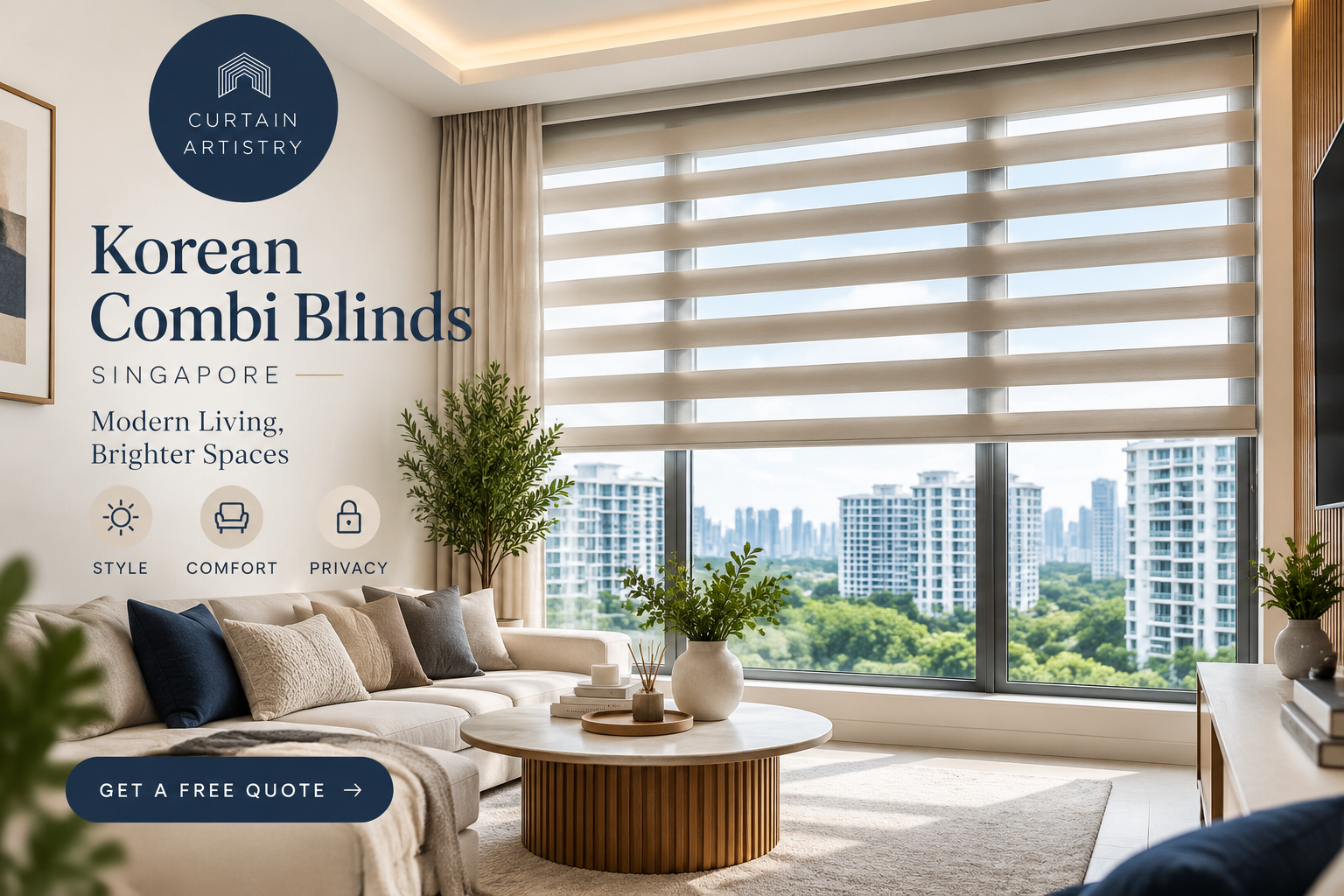
A Korean combi blind is a roller-style blind made from two fabric layers stitched into alternating horizontal stripes, one sheer and one opaque. As you raise or lower the blind, the two layers slide over each other. Align the sheer stripes and soft, filtered light comes through. Shift to align the opaque stripes and the window closes off almost completely.
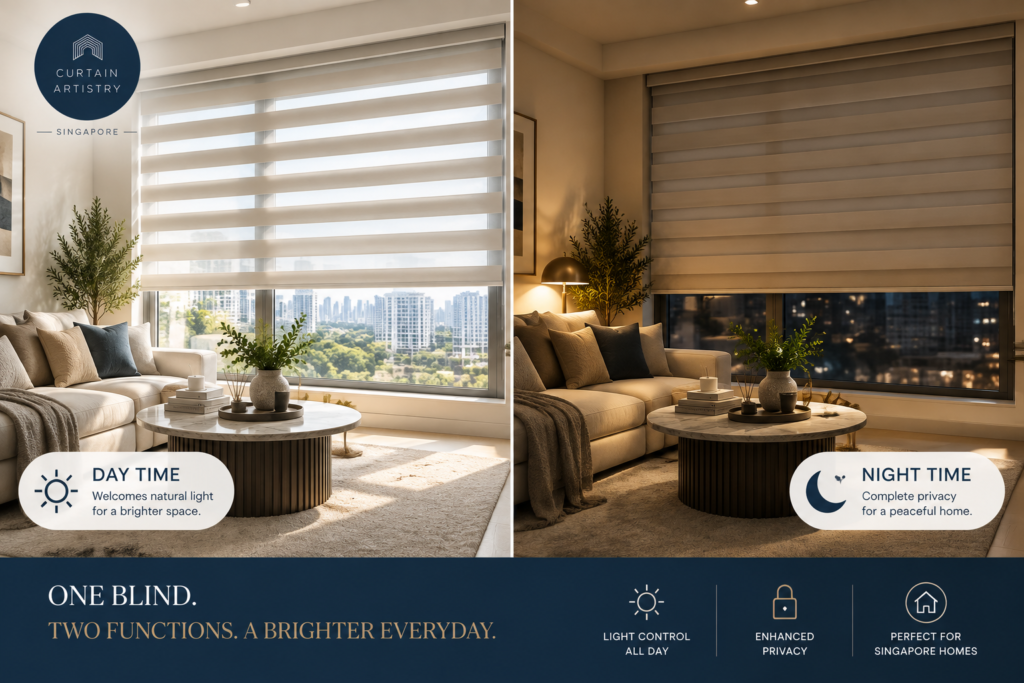
This dual-layer design is what gives combi blinds their nickname of day and night blinds. Instead of choosing between privacy and light, you adjust the alignment and get either, on the same blind, without switching to a second curtain or blind at night.
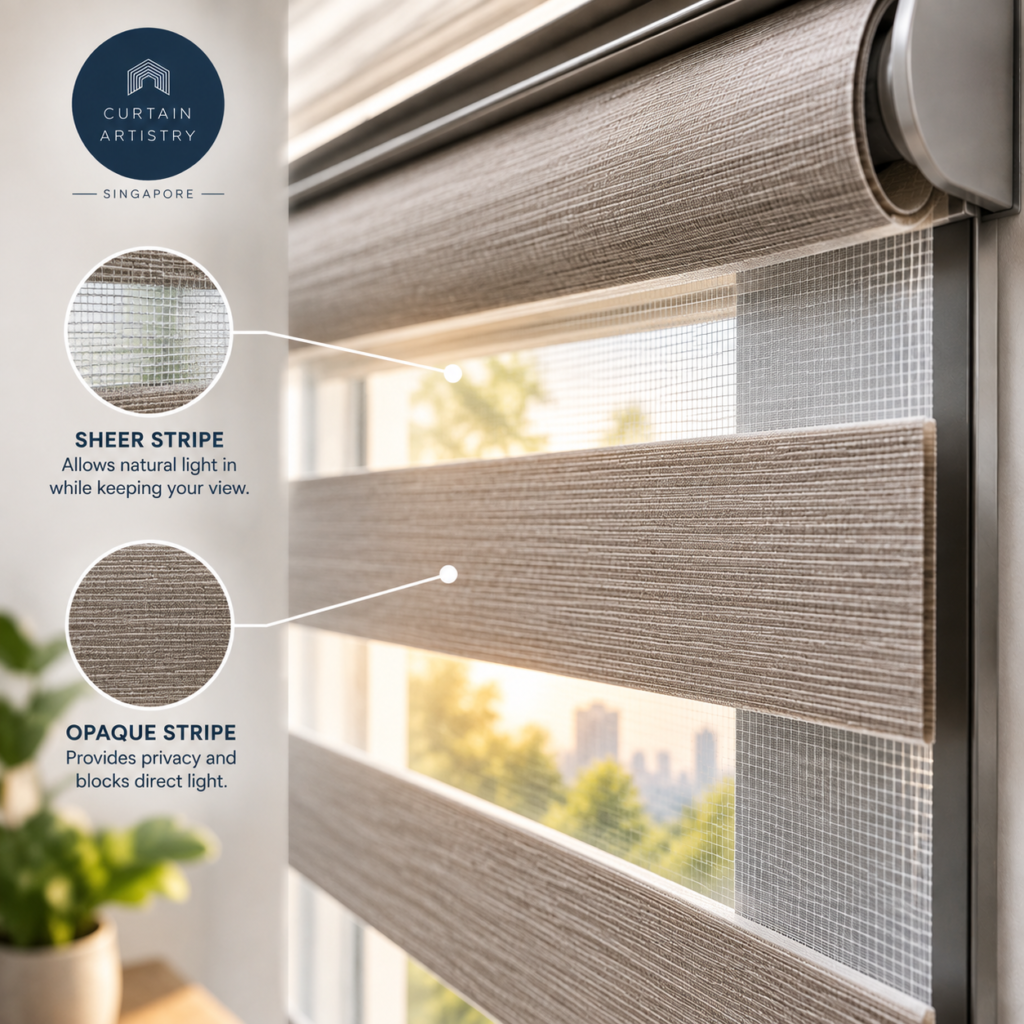
Most Korean combi blinds Singapore suppliers offer are operated with a single loop cord or chain, and motorised versions are increasingly common for larger windows or homes already set up with smart controls.
Why Singapore Homes Are Switching to Them
Korean combi blinds Singapore demand has grown for a few practical reasons that go beyond just the look.
Two functions in one blind. You get a sheer, daytime option and a more private, evening option without installing a second layer of curtains behind it.
Compact, minimalist profile. Combi blinds sit close to the window frame, which suits smaller HDB rooms where a bulky curtain track would eat into usable space.
Flexible light control throughout the day. Because you are adjusting stripe alignment rather than fully opening or closing, you can fine-tune exactly how much light comes in at any hour.
Easy to maintain. A light vacuum or a wipe with a damp cloth is usually enough to keep the fabric clean, since there are no heavy folds trapping dust the way curtain fabric can.
Works for both dim-out and blackout needs. Depending on the fabric chosen, the same style of blind can suit a bright living room or a bedroom that needs a much darker sleep environment.
Fabric colour also plays a bigger role than most people expect. Darker fabrics dim more effectively when the opaque stripes are aligned, while lighter colours let a bit more light through even in the “closed” position. Worth factoring in if your room faces strong morning or afternoon sun.
Did you know? According to the National Environment Agency, Singapore’s daily UV index typically sits between 6 and 9 due to our proximity to the equator. That is part of why light control matters more here than in temperate climates, and why so many homeowners pick dim-out or blackout fabric rather than a single fixed shade.
Korean Combi Blinds vs Roller Blinds vs Venetian Blinds
| Factor | Korean Combi Blinds | Roller Blinds | Venetian Blinds |
|---|---|---|---|
| Light control | Adjustable, sheer or opaque alignment | Fully open or fully closed | Adjustable via slat tilt |
| Privacy | High when opaque stripes aligned | High when fully closed | Moderate, gaps between slats |
| Look | Soft, striped, modern | Clean, minimalist | Structured, horizontal slats |
| Best for | Living rooms, bedrooms, home offices | Simple light blocking, any room | Offices, kitchens, wet-adjacent areas |
| Maintenance | Light vacuum or damp cloth | Low | Slightly more, dust collects on slats |
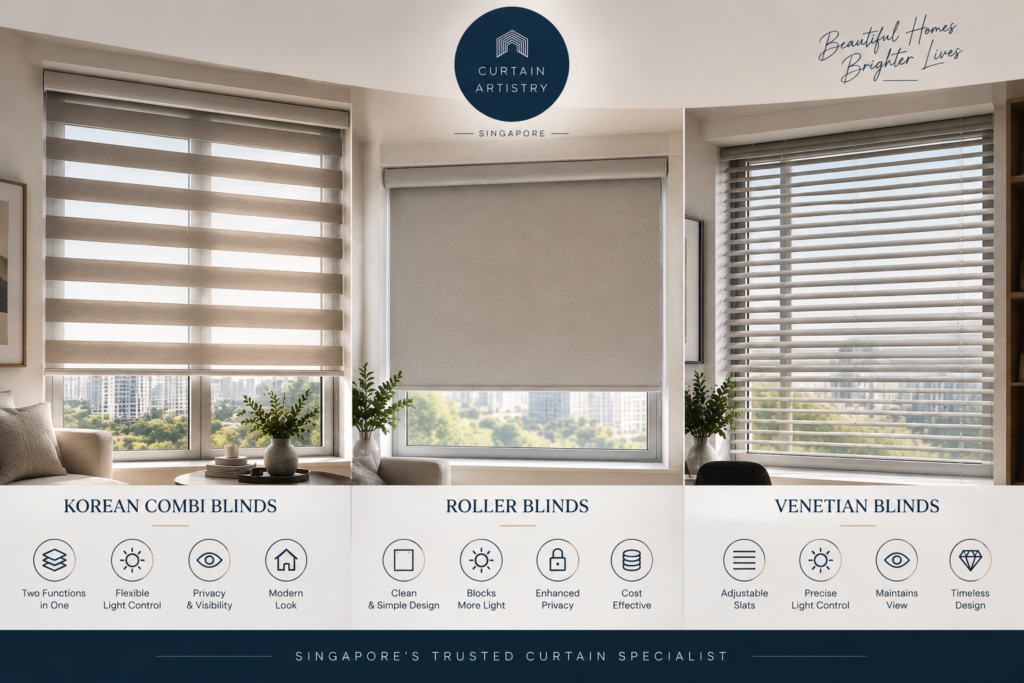
If you want one blind that adjusts to different times of day without swapping fabric, Korean combi blinds Singapore homeowners choose are usually the better fit. If your priority is a simple, low-cost light-blocking option with no need for a day and night function, a standard roller blind may be all you need.
Fabric Options, Dim-Out vs Blackout
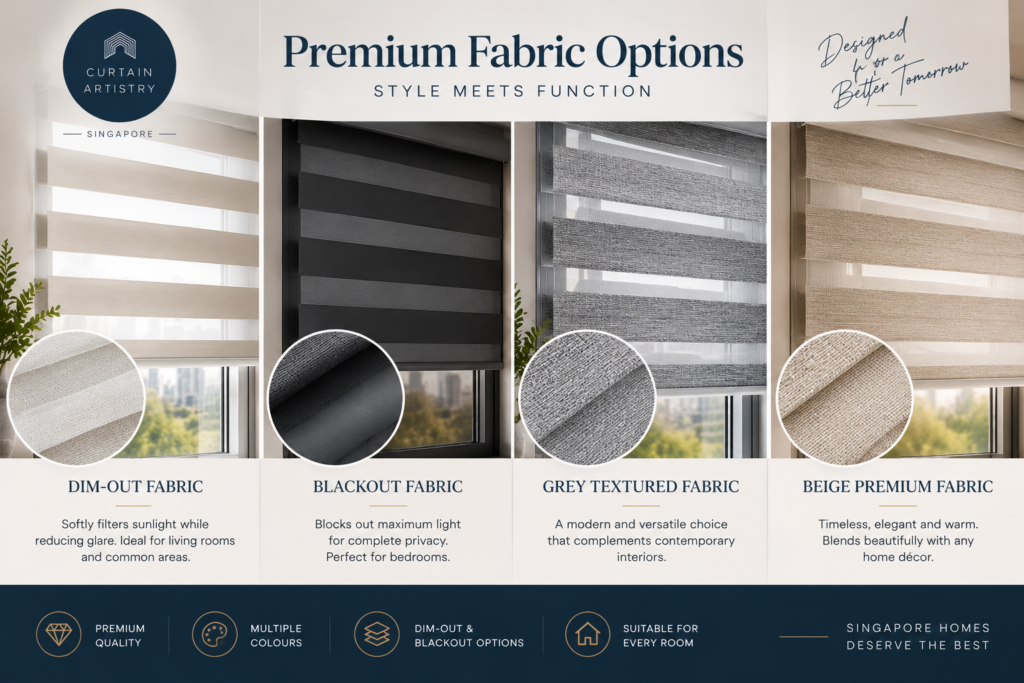
Korean combi blinds Singapore suppliers generally offer two main fabric categories.
- Dim-out fabric: Reduces light and adds privacy without full blackout, typically cutting a significant portion of incoming light depending on the fabric and colour chosen. Well suited to living rooms, dining areas, and home offices where some ambient light is still welcome.
- Blackout fabric: Designed for near-total darkness when the opaque stripes are aligned, best for bedrooms or rooms used for daytime naps, shift workers, or home theatre setups.
Colour choice affects both categories. Neutral tones like white, beige, and grey remain the most requested across Singapore homes because they suit almost any interior style, though richer tones are increasingly popular for accent rooms.
Best Rooms for Korean Combi Blinds
Choosing where to install Korean combi blinds Singapore wide comes down to how each room is actually used.
Living rooms and dining areas benefit most from the flexible daytime light control, letting you soften harsh sun without fully closing off the room.
Bedrooms work well with the blackout fabric option, giving you a single blind that handles both daytime brightness and night-time darkness.
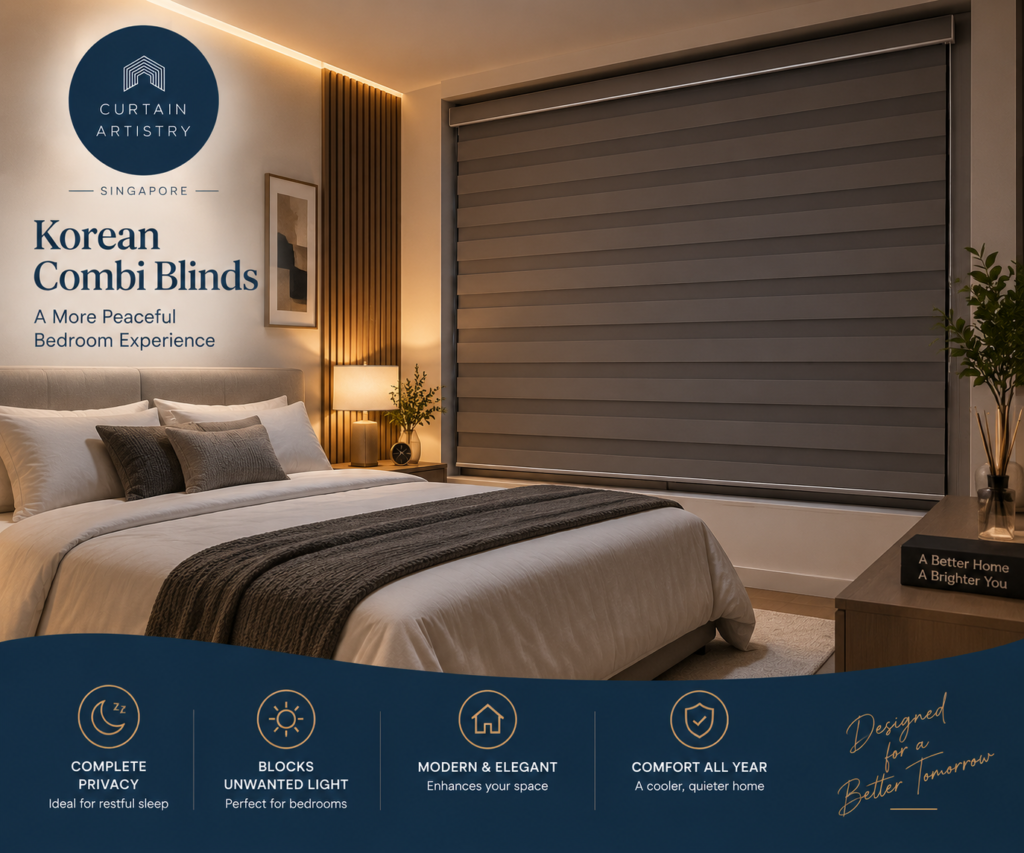
Home offices and study rooms suit combi blinds particularly well, since screen glare is easier to manage with adjustable stripe alignment than with a blind that only has an open or closed setting.
Bathrooms and other wet areas are generally not recommended for Korean combi blinds, since the fabric is not built for constant humidity exposure. A PVC-based blind or venetian style is usually a better fit there.
Pricing, What Affects the Cost
Korean combi blind pricing in Singapore depends on a few factors:
- Window size. Wider or taller windows need more fabric and a longer roller mechanism, which raises the price.
- Fabric type. Blackout fabric typically costs more than standard dim-out fabric.
- Manual vs motorised. A motorised system adds convenience but costs more upfront than a manual loop-cord version.
- Customisation. Non-standard colours or made-to-measure sizing outside typical HDB window dimensions can affect the final quote.
Because window sizes and requirements vary so much between HDB, condo, and landed homes, the most accurate way to get pricing is through an on-site measurement rather than a general estimate.
Choosing an Installer
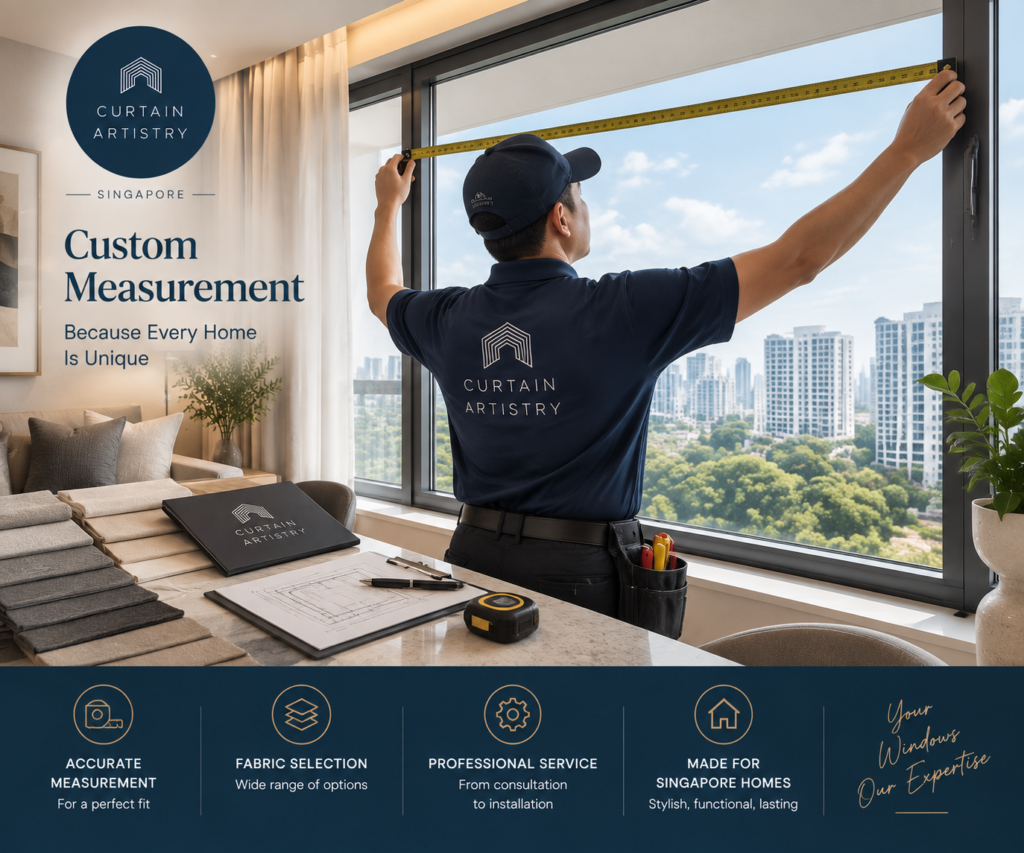
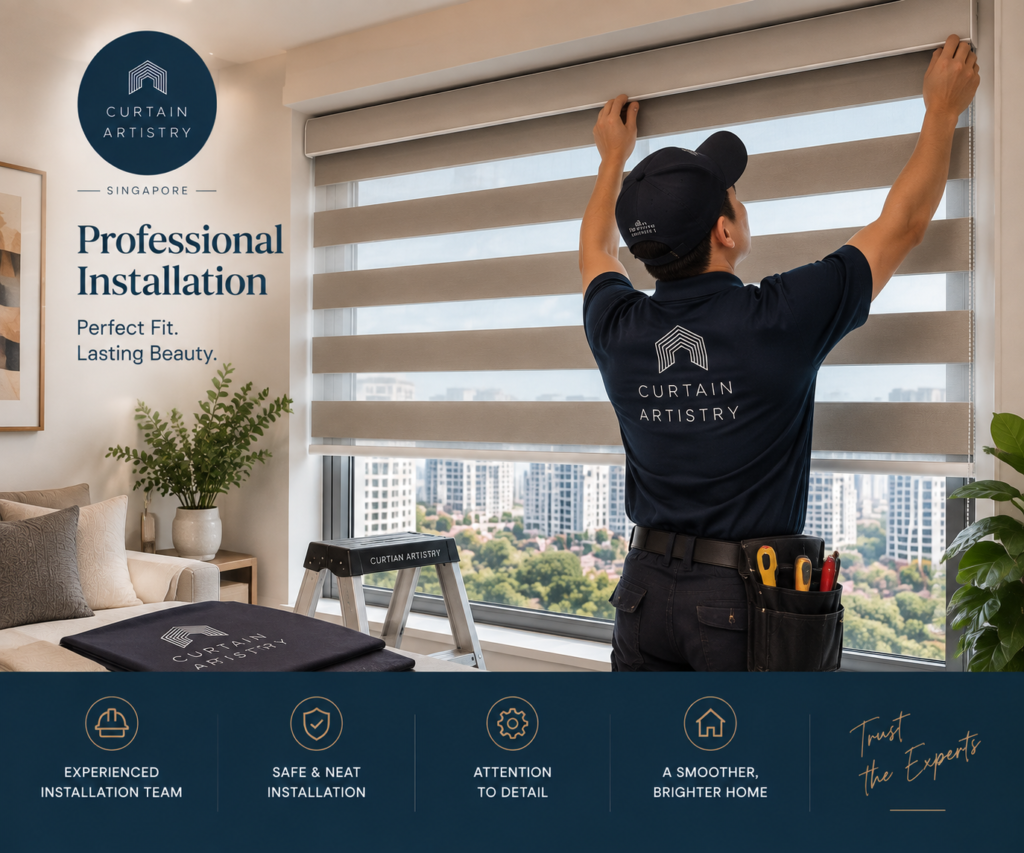
At Curtain Artistry, we measure your windows on-site and help you choose between dim-out and blackout fabric based on how the room is actually used, not just how it looks in a sample swatch. Whether you need a single combi blind for a home office or a full set across an HDB flat, our team handles fabric selection, measurement, and installation from start to finish.
Before committing to an installer, it is worth asking a few questions: how they handle warranty on the roller mechanism, whether motorisation is available if you want to upgrade later, and how quickly they can turn around installation once measurements are confirmed.
FAQ
What are Korean combi blinds also called? Korean combi blinds Singapore homeowners install are commonly known as zebra blinds, rainbow blinds, shadow blinds, or day and night blinds, all referring to the same dual-layer, alternating stripe design.
Can Korean combi blinds fully block out light? Yes, if you choose the blackout fabric option and align the opaque stripes fully. Dim-out fabric will reduce light significantly but is not designed for full blackout.
Are Korean combi blinds suitable for small HDB rooms? Yes. Their compact, close-to-frame profile makes them a good fit for smaller rooms where a bulky curtain track would take up too much space.
How do I clean Korean combi blinds? A light vacuum on a low setting or a wipe with a soft, damp cloth is usually enough. Avoid soaking the fabric, since the layered construction is not designed for heavy washing.
Are Korean combi blinds a good option for bathrooms? Not generally. The fabric is not built for constant humidity, so a PVC-based blind or venetian style is usually a better fit for wet areas.
Ready to Try Korean Combi Blinds in Your Home?
Whether you want better light control in your living room or a single blind that handles both day and night in your bedroom, Korean combi blinds Singapore homeowners are choosing offer a flexible, low-maintenance option. Get in touch with Curtain Artistry for a free consultation and quote, and let our team help you choose the right fabric and finish for your space.
Have you tried combi blinds in your home yet, or are you still deciding between combi and a standard roller blind? Let us know what is holding you back.